
How the game works
A strategy card game built on connections, combinations, and scoring efficiency.
Learn how Presidency or Prison works, including its mechanics, systems, and gameplay structure.
Presidency or Prison is a strategy card game where players build connected card structures to generate points. Cards gain value through their base points, their edges, and their interactions with other cards already in play.
The system evolves as cards are added, removed, or disrupted. The goal is to outscore the Dotard by building efficient, high-value combinations while using truth and structure to counter misinformation.
For the project framing, read why this game exists.
The core loop
Each turn asks the same strategic question in a new form: what do you gain, what do you risk, and what are you setting up next?
Core mechanics overview
Players draw, play, and connect cards to build scoring structures. The objective is to optimize how cards are laid to generate the highest number of points through combinations and edges.
Decisions affect outcomes through card placement, connections, timing, and interaction with the Dotard's actions.
If you want the short version of what the project is, read what Presidency or Prison is. If you have questions, check the FAQ.
Step 1 — Draw into the system
Players act within a shared system rather than isolated personal engines. What enters play affects everyone.
Step 2 — Make a move
A move can change scoring, alter connections, create new combinations, or introduce constraints.
Step 3 — Trigger consequences
Actions are not neutral. Each move affects the current structure through card interactions, connections, and effects such as binding or revival.
Step 4 — Recalculate position
A strong position can change depending on what the Dotard draws and how it affects the cards and connections in play.
Step 5 — Win the game
Victory comes from building higher-scoring structures than the Dotard through efficient card placement, connections, and timing.
Every move strengthens your position—but can also introduce new vulnerabilities.
“Prices are going to come down fast… and we’re going to reduce the debt quickly.” — The Dotard.
Satire framing
PoP uses satire to transform documented public behavior into structured strategic tension. Real figures and events matter here because public decisions under pressure create real consequences. The game turns those patterns into play rather than reducing them to slogans.
The World Behind the Game
The mechanics of Presidency or Prison are grounded in a fictional world—but that world reflects real patterns.
- Some cards represent the influence of Blue Candy—ideas that feel good but distort reality
- Others reflect the spread of narratives shaped by Dotard’s influence
- And some represent attempts to resist, question, and uncover truth
As you play, you’re not just making moves—you’re navigating a system of belief, influence, and perception.
Rooftop
Whatever you have spoken in the dark will be heard in the light, your secrets will be proclaimed on the rooftops
“They’re taking our jobs… this is an invasion.” — The Dotard
Want the deeper reason behind the project?
Read why this system exists and what patterns of public life it is responding to.
Game mechanics at a glance
Players use cards to build a shared structure that can strengthen, weaken, or shift as the game unfolds. Card interactions shape how points are gained, how effects combine, and how positions can reverse over time.
Each decision affects what becomes possible next. As the game progresses, earlier choices continue to influence the state of play.
- Player Count: 1+ (player(s) team play against the deck)
- Playtime: 20-60 minutes; quick-play variants available
- Complexity: Scalable difficulty
- Mode: Cooperative Players vs the Dotard
- Core Mechanic: Shared-deck Red/Blue pill execution system
Secondary mechanics
- Conditional binding effects
- Adjustable scoring parameters (variant-based)
- Edge bonuses
- Card revival and interaction chains
Gameplay loop (current structure)
Before the game begins, players select a difficulty setting. This determines how strongly the Dotard's attacks are amplified.
- 1. The Dotard begins each round by drawing a card and immediately executing its Blue pill, applying attack points based on the chosen difficulty and triggering destabilizing effects.
- 2. Players take turns in sequence within each round, choosing to draw from the shared deck or play a card from their hand.
- 3. When a player plays a card, its Red pill activates — adding points and triggering its effects within the shared system.
- 4. Some Blue pill effects can bind player cards, temporarily suppressing their scoring and interactions.
- 5. As rounds progress, the shared system evolves based on what has been played, disrupted, or restored.
- 6. The game concludes under predefined variant rules; the final score determines the outcome.
Win condition
When the game concludes, if the Players outscore the Dotard, accountability prevails.
Who this game is for
This game is for players who enjoy building a system together - knowing it will be tested, disrupted, and reshaped as it grows.
It tends to resonate with people who enjoy:
- Collaborative strategy, where players coordinate rather than compete directly
- Systems where connections matter as much as individual pieces
- Gameplay where disruption and recovery are part of the strategy
- Watching structure emerge - and seeing how easily it can be destabilized
Trending Cards
Cards getting the most attention from opens, shares, and downloads.
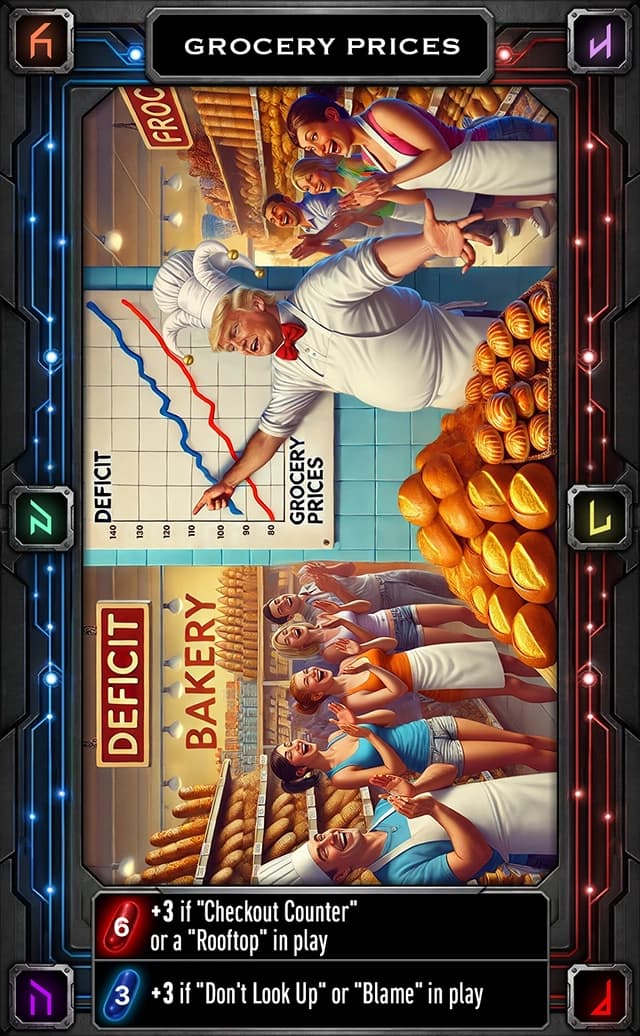
Grocery Prices
Donald Trump’s promises to reduce grocery prices versus actual changes in overall food-at-home (grocery) prices during his second term, focusing on broad market outcomes rather than isolated price swings or government-supported interventions.
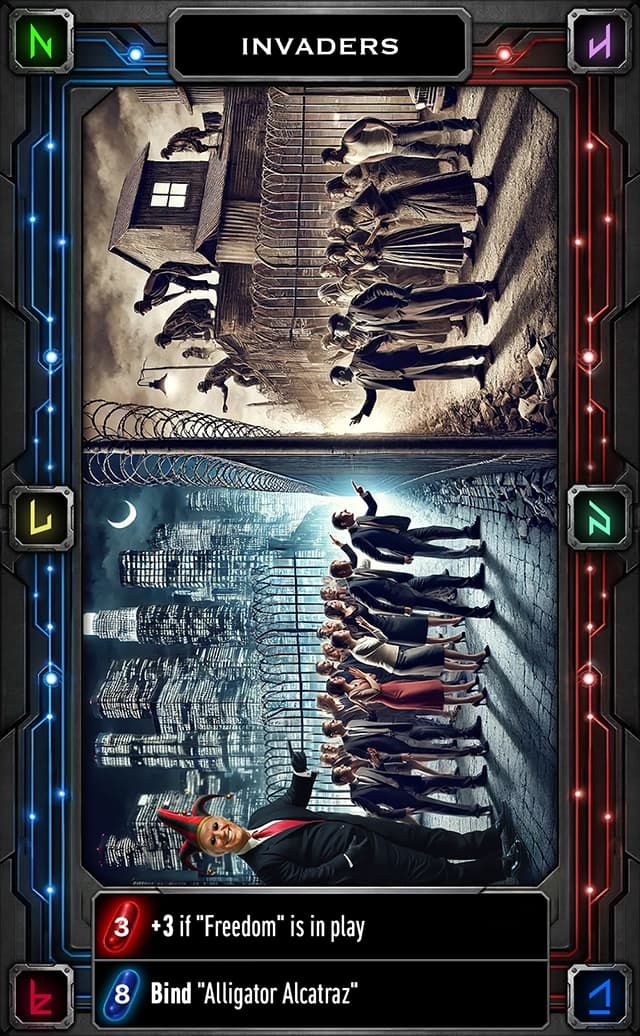
Invaders
Donald Trump repeatedly framed unauthorized immigration as an “invasion” and claimed immigrants were “taking” Americans’ jobs, while enforcement policy and visa restrictions intersected with labor markets where immigrants—both undocumented and legal—are heavily concentrated, including agriculture, construction, food processing, and STEM.
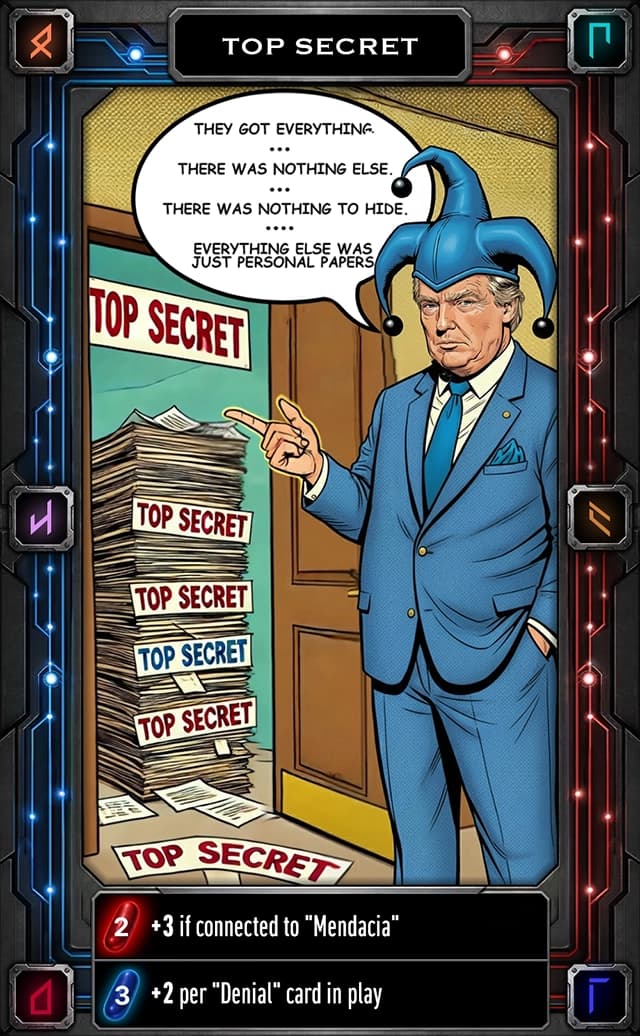
Top Secret
Donald Trump’s handling of classified documents after leaving office; storage at Mar-a-Lago; representations of compliance; subsequent recoveries; public statements; and alleged concealment and sharing.

Space Command
Donald Trump’s decision to relocate U.S. Space Command headquarters from Colorado to Alabama, including stated justifications, projected costs, political controversy, and expert debate over whether the move benefits national security or reflects political motivations.
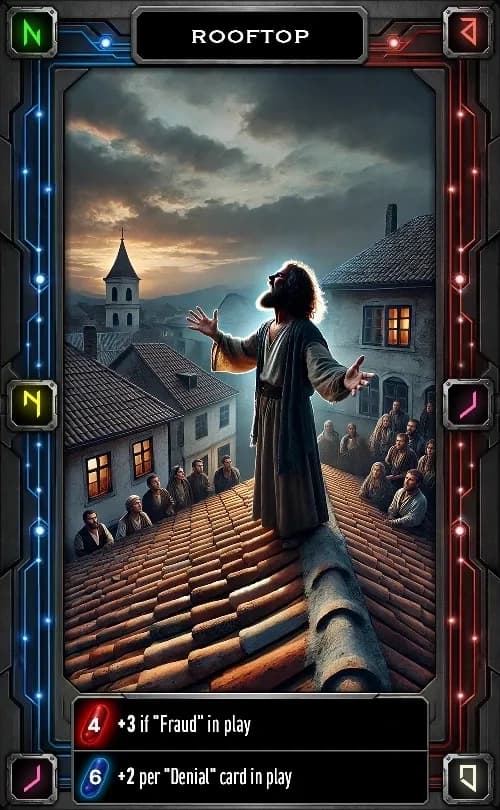
Rooftop
A symbolic card grounded in Biblical teachings about truth, exposure, and moral accountability - emphasizing that hidden actions are revealed, individuals are known by their "fruits," and that outward religious identity can be evaluated against observable conduct.
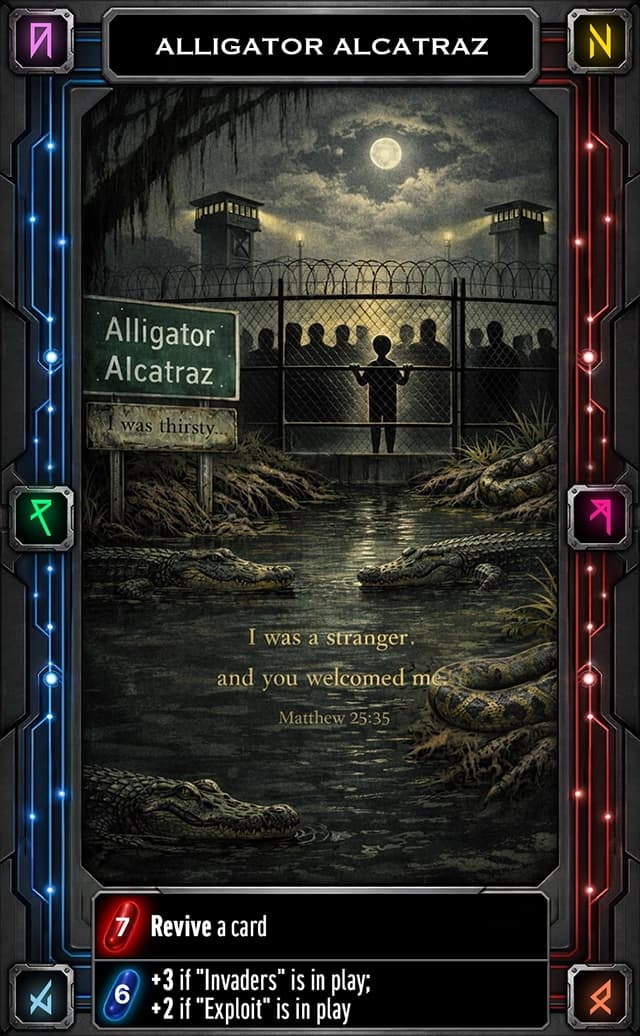
Alligator Alcatraz
A remote Florida Everglades-area immigration detention facility and broader ICE detention practices involving work-for-pay programs, paid phone access, conditions of confinement, attorney access barriers, and humanitarian concerns — including comparisons by critics to “concentration camps.”
Next steps
Stay informed on playtesting and the campaign timeline.
Join early to follow development and launch updates.